

Why Is Your Commercial Refrigerator Not Holding the Right Temperature?

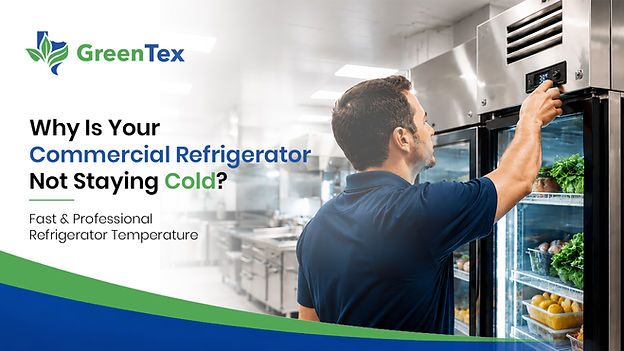
A commercial fridge that cannot maintain a consistent temperature is not just an inconvenience. It is a food safety problem. Even a few degrees of drift can spoil inventory, trigger compliance issues, and cost far more than a timely repair would have. That is exactly why getting service for professional commercial refrigeration repair in Dallas, TX, is important. A qualified technician has the tools and training to find what is actually wrong and fix it right.
Table of Content
Why Does a Walk-In Cooler Keep Losing Temperature?
Can Dirty Condenser Coils Make a Commercial Refrigerator Stop Cooling?
When Is Emergency Refrigeration Repair in Dallas Needed for a Cooling Issue?
How Does Refrigerant Leak Detection and Repair Help Restore Cooling?
Can Commercial Kitchen Equipment Failure Affect Refrigerator Temperature?
Why Does a Walk-In Cooler Keep Losing Temperature?
Walk-in coolers run constantly, are opened dozens of times a day, and still need to stay between 33°F and 40°F. When a walk-in cooler is not maintaining temperature, the cause usually comes down to airflow problems, mechanical wear, or refrigerant issues.
The first thing a technician checks is airflow. Blocked vents and overstuffed shelves are common culprits that prevent cold air from moving through the unit properly. Mechanical wear is harder to spot. A door gasket that appears intact can still be losing cold air in ways you would never notice just by looking at it. Technicians use a simple dollar-bill test for this: shut the door on it, then pull it out. If it comes out without resistance, the seal needs attention.
Beyond the basics, here is what a technician actually digs into:
Evaporator fan: if this fails, cold air stops distributing evenly. Some spots freeze, others warm up, and the thermostat starts getting inaccurate readings.
Thermostat and sensor calibration: a faulty sensor can report normal temperatures even as the cabinet drifts. Nothing on the display warns you.
Defrost cycle: if it runs too often or does not complete, ice builds up on the evaporator coil and blocks airflow entirely.
Can Dirty Condenser Coils Make a Commercial Refrigerator Stop Cooling?
Yes, and it happens more than you would think. The condenser coil releases heat from the system. When it is caked in dust, grease, and kitchen debris, it simply cannot do that. The unit keeps running, energy bills go up, and temperatures still do not drop where they should.
Dirty condenser coils in a commercial refrigerator should be cleaned every three to four months. A technician will properly clean them, check that there is sufficient clearance around the unit for airflow, and ensure the condenser fan is working as it should.
It is an easy thing to put off, but dirty coils push the compressor too hard. Replacing one costs way more than a simple cleaning.
When Is Emergency Refrigeration Repair in Dallas Needed for a Cooling Issue?
While not every temperature problem needs an emergency call, some things genuinely cannot wait. Emergency refrigeration repair in Dallas is the right call when:
Temperatures go above 41°F, and the unit is not recovering.
The compressor keeps running, but nothing is getting colder.
There are clicking, grinding, or unusual sounds that were not there before.
Ice is showing up inside the cabinet where it has no business being.
Circuit breakers keep tripping every time the unit turns on.
The risk in waiting is not just the food loss. Running a unit that is already struggling pushes the compressor harder than it can handle. A compressor that could have been saved with a quick repair can burn out completely if the unit keeps running under that kind of stress.
The smartest move is to shift perishables to backup storage, check temperatures with a separate thermometer rather than trusting the display, and call a licensed technician right away.
How Does Refrigerant Leak Detection and Repair Help Restore Cooling?
Refrigerant is what actually does the cooling. It pulls heat out of the cabinet and moves it outside through the condenser. When there is a leak, that level drops and the unit just stops keeping up. The compressor runs, the fans spin, everything sounds normal, but the temperature inside keeps going up.
This is not something anyone can fix without the right training and equipment. Refrigerants are regulated in the US, and tracking down a leak takes specialised tools that a regular kitchen does not have. A licensed technician checks the system pressures, locates the leak and properly recharges everything once it is sorted.
Here is the thing, though: just topping off the refrigerant without fixing the leak does nothing in the long term. It will drop again. A proper repair means finding where it is coming from and fixing that first.
Can Commercial Kitchen Equipment Failure Affect Refrigerator Temperature?
Yes, it actually can. A fridge sitting next to a fryer or oven is constantly fighting the heat those appliances put out. That alone can raise temperatures, even when the unit itself is perfectly fine. Power fluctuations or sharing a circuit with heavy equipment can also affect how consistently the compressor cycles. A good technician looks at the whole kitchen, not just the fridge. Operational habits matter too:
Propping refrigerator doors open during busy service periods causes rapid temperature loss.
Loading the unit with large quantities of warm, prepped product all at once, temporarily overtaxes the system.
Poor ventilation clearance around the unit, traps heat and reduces condenser efficiency.
Conclusion
Every temperature problem has a cause. Finding it early is what keeps a small repair from turning into a major expense. GreenTex Cooler Solutions specialises in commercial refrigeration repair in Dallas, TX, and focuses on finding the root cause rather than just applying a temporary fix. Reach out before a small issue turns into a bigger one.
Coming up next is a closer look at what a professional maintenance schedule for a commercial kitchen actually looks like. Stay tuned.
Frequently Asked Questions
How often should a commercial refrigerator be serviced?
Most technicians recommend a professional inspection every three to four months, though busy kitchens with heavy grease output may need it more frequently.
What temperature should a commercial refrigerator be set to?
A commercial refrigerator should stay between 33°F and 40°F at all times to keep food safe and meet health compliance standards.
Can a commercial refrigerator run but still not cool properly?
Yes, a unit can appear to be running normally while the internal temperature is drifting, which is why checking with a separate thermometer is always more reliable than trusting the display.


Comments